Campus Connect
Project Overview
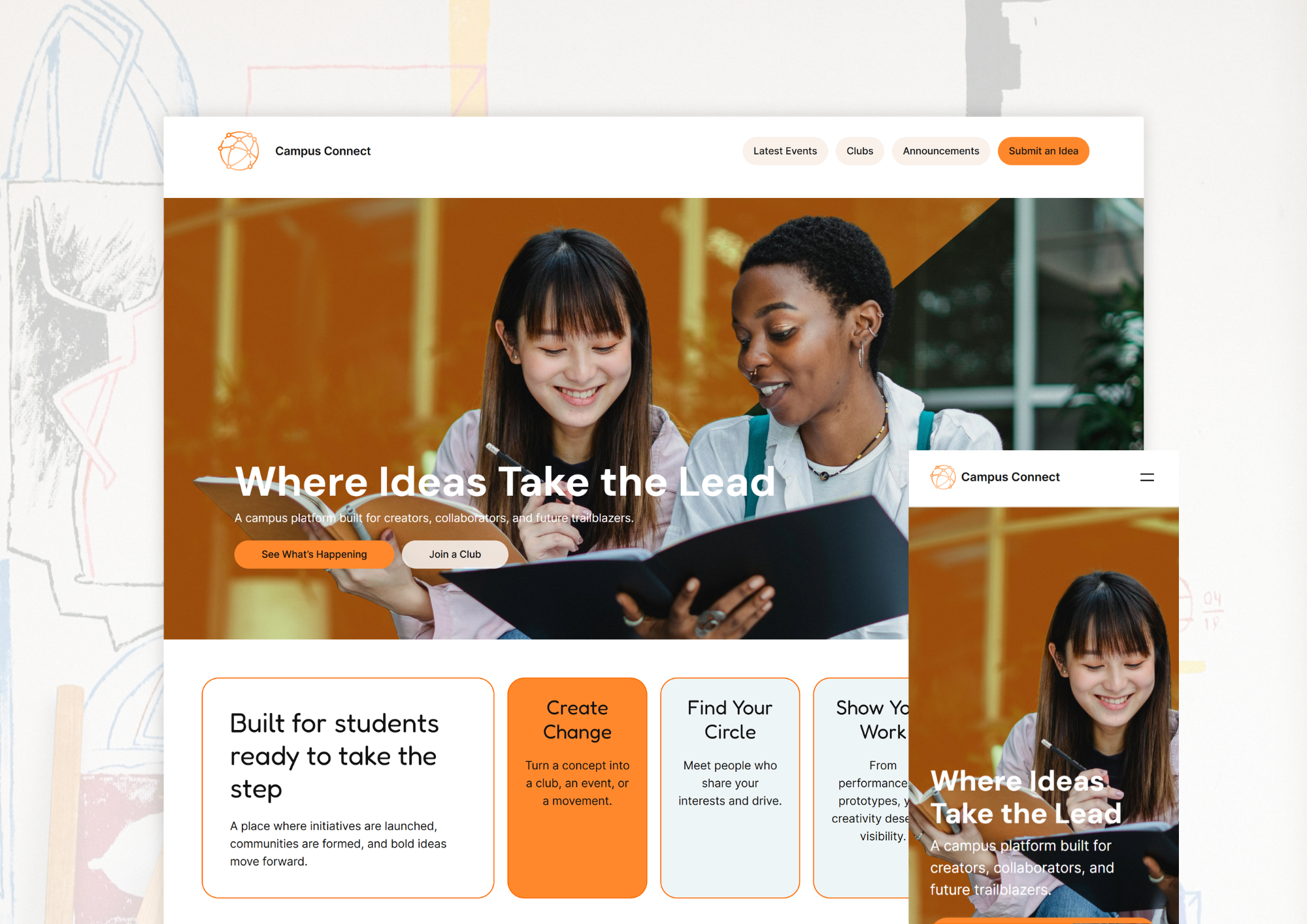
Campus Connect is a concept platform designed to centralise communication within a school community. The goal was to create a structured hub for events, announcements, and participation. The site was built using WordPress Gutenberg with customisation of the Twenty Twenty-Four theme.
Problem
School communication is often fragmented, making it difficult for users to stay informed and engaged. Some challenges include:
• Low visibility of events.
• Disorganised information.
• Limited participation.
This reduces awareness and engagement across the community.
Approach & Process
The design focused on transforming scattered information into a structured, user-friendly system. Key decisions includes prioritising event visibility, introducing clear content categories, and also encouraging interaction through actionable entry points.
The project followed a structured SDLC approach, combining design validation and component-based development. This process translated a complex, content-heavy concept into a structured and accessible interface.
Planning & Requirements
The project focused primarily on students as the core user group, with a focus on improving engagement and simplifying access to campus information.
Design
Content architecture was developed directly in a Gutenberg template, using block layouts to organise events, categories, and actions.
Development
The Twenty Twenty-Four theme was customised to create a clean, modern interface. Layout patterns were standardised to support scalability and consistency.
Testing
Content sections were reviewed to reduce clutter and improve usability. Visual hierarchy and CTA placement were refined to guide user interaction. Site responsiveness was also ensured.
Technology & Implementation
The platform was built using WordPress Gutenberg, enabling modular and reusable layouts. This project focuses on theme customisation and uses Twenty Twenty-Four as the base theme, as such, it enables consistent design pattern, flexible content organisation, and scalable page structures.
The system was designed to accommodate future expansion into a more dynamic platform.
Tech Stack:
Additional UX considerations included introducing system-like elements such as event categorisation and action-oriented sections.
Outcome
The final design presents a structured and accessible communication hub that simplifies how students discover and engage with campus events.
This project demonstrates my ability to:
• Simplify scattered information into a clear, user-centred layout.
• Improve content clarity and reduce visual and cognitive overload.
• Design interfaces that highlight key actions without overwhelming the user.