Farm Employee & Time Management System
Project Overview
The Farm Employee and Time Management is a proof-of-concept web application developed for Beerenberg Family Farm to digitise workforce time tracking, roster management, and payroll processes.
The project was delivered within an Agile DevOps environment over multiple sprints, involving a cross-functional team. I contributed as a UI/UX designer and full-stack developer, working across both the presentation and application layers.
Problem
Beerenberg Family Farm relied on manual, paper-based processes and spreadsheets to manage attendance, rosters, and payroll. This created several operational risks:
• Inaccurate time tracking and payroll calculations.
• Delays in payslip generation.
• Increased administrative workload.
• Risk of non-compliance with Fair Work regulations
These issues highlighted the need for a reliable, centralised system that could improve accuracy, accountability, and operational efficiency.
Approach & Process
The strategy focused on replacing fragmented manual workflows with a centralised, automated system that supports both operational staff and administrators. Key strategic decisions included:
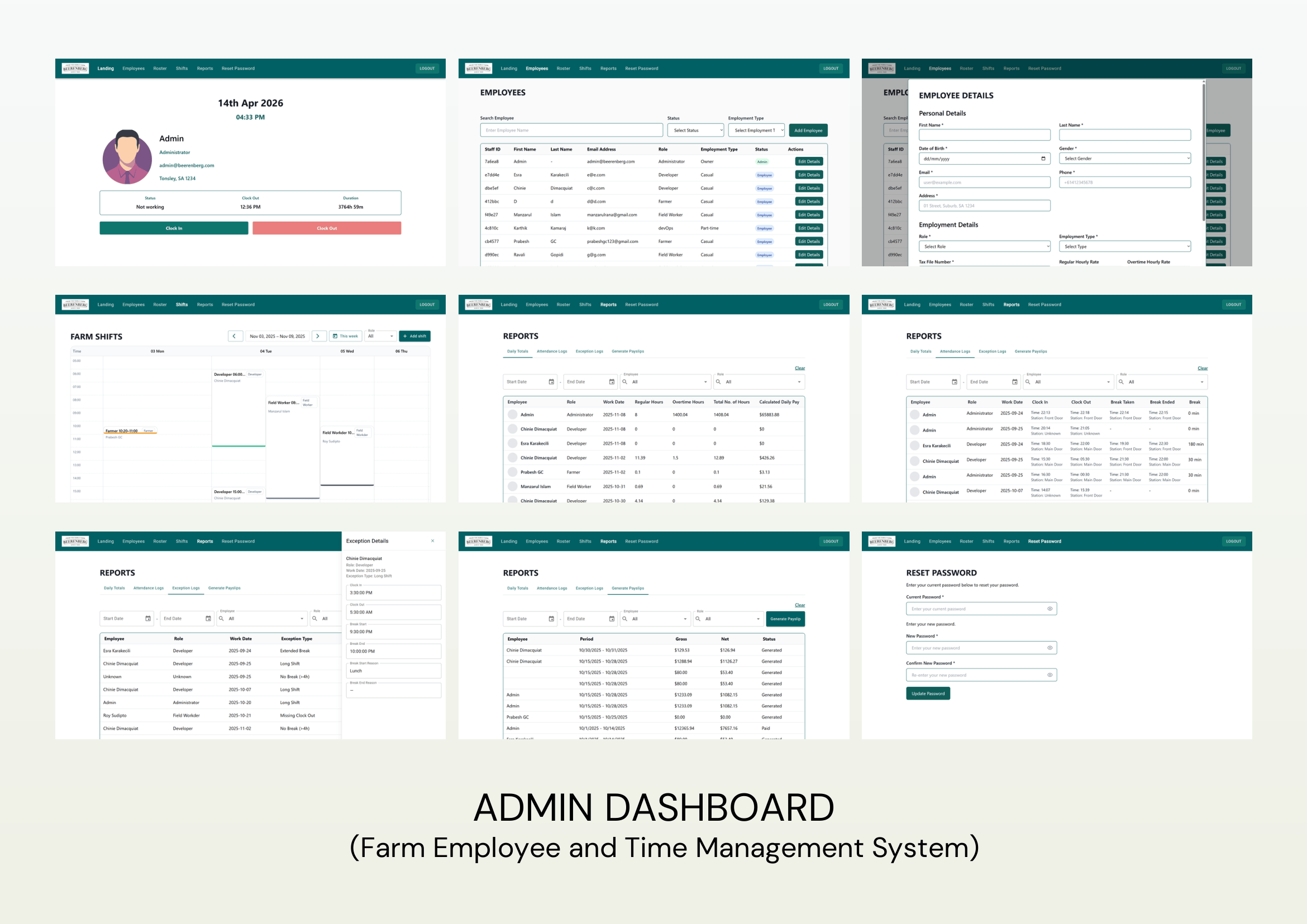
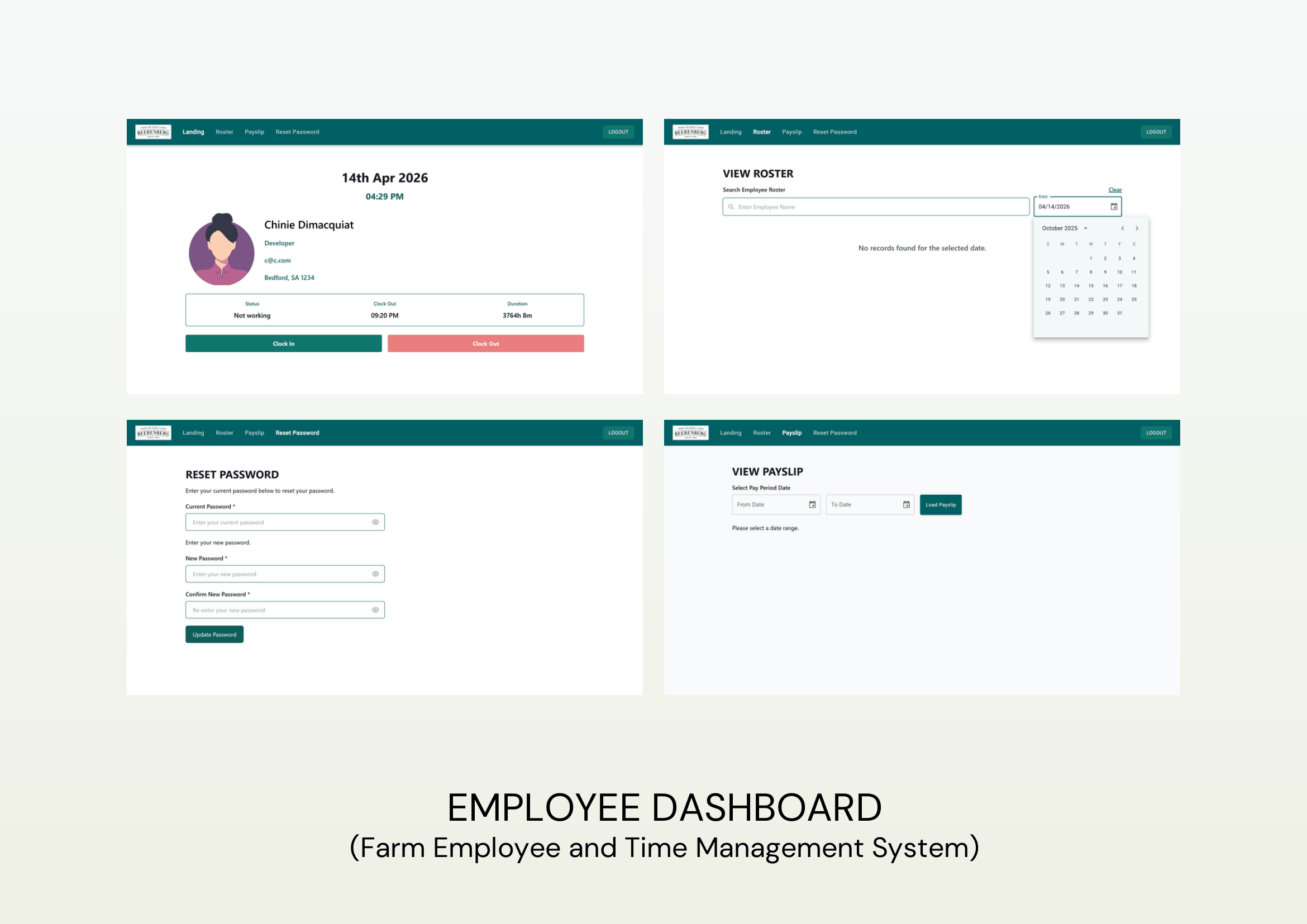
• Designing a dual-interface system for employee and admin roles.
• Prioritising automation of repetitive tasks such as attendance tracking and payroll generation.
• Ensuring offline capability through on-premises deployment.
• Structuring the system to align with compliance requirements.
The project followed an Agile SDLC approach, delivered over multiple sprints using Azure DevOps.
Planning & Requirements
Business analysts and stakeholders defined requirements focused on automation, compliance, and operational efficiency.
Design
Wireframes, low-fidelity, and high-fidelity designs were created to define system layout, role-based interfaces, and data presentation, ensuring usability before development.
Development
Features were implemented incrementally, including: staff management, rosters and shifts, attendance logging, reporting, and payroll automation.
Testing
Comprehensive testing was done throughout the whole process ensuring functionality, usability, and reliability. This testing includes: unit, integration, system, regression, UI, security, and automation testing.
Deployment
Azure DevOps pipelines supported continuous integration and deployment, enabling iterative delivery and refinement.
Technology & Implementation
The system was developed using a layered architecture:
Design
Figma for interface design and prototyping
Frontend
React (Vite), Material UI, Tailwind CSS
Backend
Node.js and Express.js for RESTful APIs
Database
MongoDB which was used locally and for its cloud flexibility
Security
JWT authentication, bcrypt hashing, and rate limiting
DevOps
Azure DevOps including its CI/CD pipelines, sprint tracking, and Git
Testing
Cypress for automated UI testing, along with manual testing
Tech Stack:
The interface follows a minimalist and functional design approach, prioritising clarity and efficiency over visual complexity. Design decisions were guided by:
• Desktop-first layouts which is aligned with farm hardware constraints.
• Clean typography and structured tables for readability.
• Consistent UI patterns across modules.
• Minimal visual noise to support quick decision-making.
The goal was to create a system that is easy to learn, fast to use, and reliable in high-frequency tasks. Meanwhile, the UX design focused on reducing friction in repetitive administrative and operational tasks. Key considerations included:
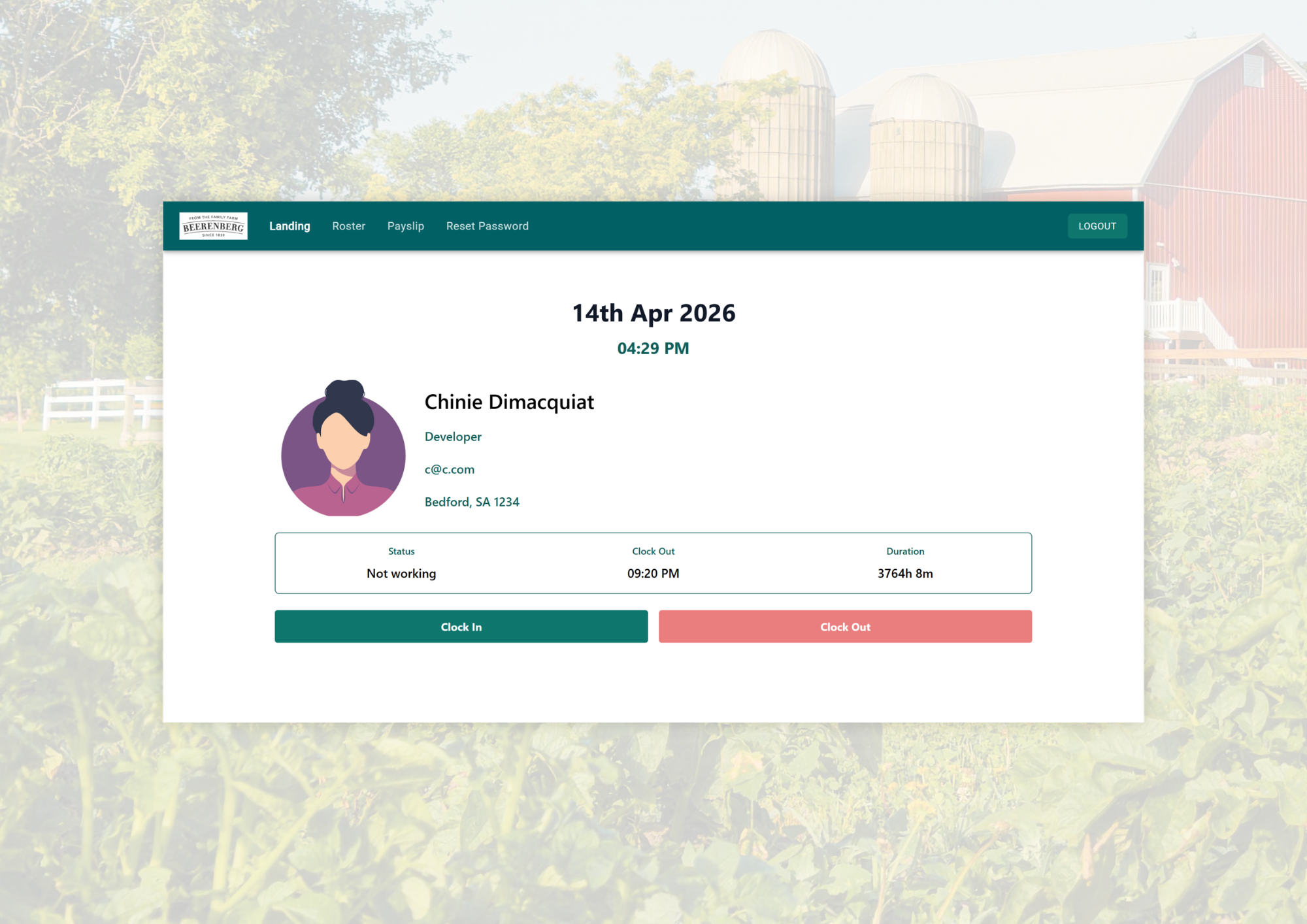
• Making clock-in/out actions immediately accessible after login.
• Using table-based layouts with filters for efficient data management.
• Providing clear status indicators (e.g. working/not working).
• Separating admin and employee views to reduce complexity.
• Supporting quick actions (add, edit, delete) through modal interactions.
Outcome
The FTMS provides a centralised platform that improves accuracy, reduces manual processes, and enhances compliance with labour regulations. This project demonstrates my ability to:
• Apply full SDLC within a collaborative Agile DevOps environment.
• Design and develop full-stack systems.
• Translate business problems into scalable digital solutions.
• Collaborate within a cross-functional development team.
chinie
dimacquiat
PORTFOLIO 2026
© All Rights Reserved.